Lucy Barka, a.k.a. Luce, is a singer-songwriter from South Cambridgeshire who has made an album about her recovery from rape.
I've always sang. From primary school, I’ve always been performing, acting, dancing, doing accents - taking after my Mum. I’ve always been a sister, a daughter, a friend.
In Sixth Form, I was studying Theatre, Performance, and English Literature, on course for top grades and drama school applications.
Then, in the summer of aged seventeen, I was raped, changing the course of my life.
The perpetrator was someone I’d considered a friend, studying drama at the same college, though not in my classes. Since the event didn’t fit my idea of “what rape is”, I wrote it off as “bad sex I didn’t want to happen”.
After telling my brother, who said it definitely is rape, he encouraged me to tell my Mum and I told her I wanted to carry on as if nothing had happened.
I don’t have many memories of the year in the aftermath - maybe because I was living with PTSD. I was almost living in parallel; my inner world was so different to what it used to be.
I somehow navigated my way through what were - and what I didn’t know at the time to be - panic attacks and dissociation. Somewhere along the way, convinced it wouldn’t be worth the effort, and a total loss of passion, I decided not to go to drama school and instead go to uni to do English.
I carried on living and ended up studying English and Creative Writing at the University of Birmingham. I’d never really been a writer so I was terrible at first but writing became central to my recovery.
Finding my voice again after rape
In third year, having spent two years not singing or performing, I joined an all-female acapella group. This was the most wonderful experience. So healing and cathartic, and I learned I wasn't the only survivor or person dealing with mental health problems.
One of my friends from the group helped me to recognise I’d been a victim of a crime; that I had rights; that there are laws in place meant to prevent what I’d experienced. She walked me through how I could report it to the police, being in full control of the early process, just giving his name, what happened, and then I could stop there.
Finding where you have agency is such an important part of recovery.
There’s already so much not in your control.
When it came to the police report, knowing I could stop or continue as I wished made me feel brave enough to take it on. I’ll always be grateful for the support from that friend.
That was kind of my first big step in acknowledging the truth (nearly 3 years after the event). I had recognised, by that point, I was suffering. PTSD had reared its ugly head in my poetry and journaling: the numbness, the dissociation, the pain…
Free-writing as part of my creative process made me witness my inner world: I couldn’t carry on as if it was nothing anymore. And gradually, there were shifts: I was singing again, performing poetry, even started writing songs.
When considering a post-grad, it was between Poetry or Songwriting, but as soon as I arrived at music college, I was exactly where I needed to be.
Becoming a compassionate observer
In the first semester of the Songwriting MA (at ICMP), I had a disagreement with the facilitator of a group coaching session. The facilitator (who became a dear friend and my research supervisor) was talking about “being the author of your life” and “writing the story” of who you are.
Something about this triggered me so I confronted him.
I disagreed: it’s important to acknowledge when you’ve been a victim - if I’m an author 100% of the time, it’s like I’m saying I chose to be raped, as if I wrote that (confirming the victim-blaming narratives of “I should have used violence to stop him”).
I was only just starting to argue with those narratives in my head, and for someone else to seemingly back it, it was triggering. Fortunately, the facilitator welcomed my confrontation and we explored it together privately after the session.
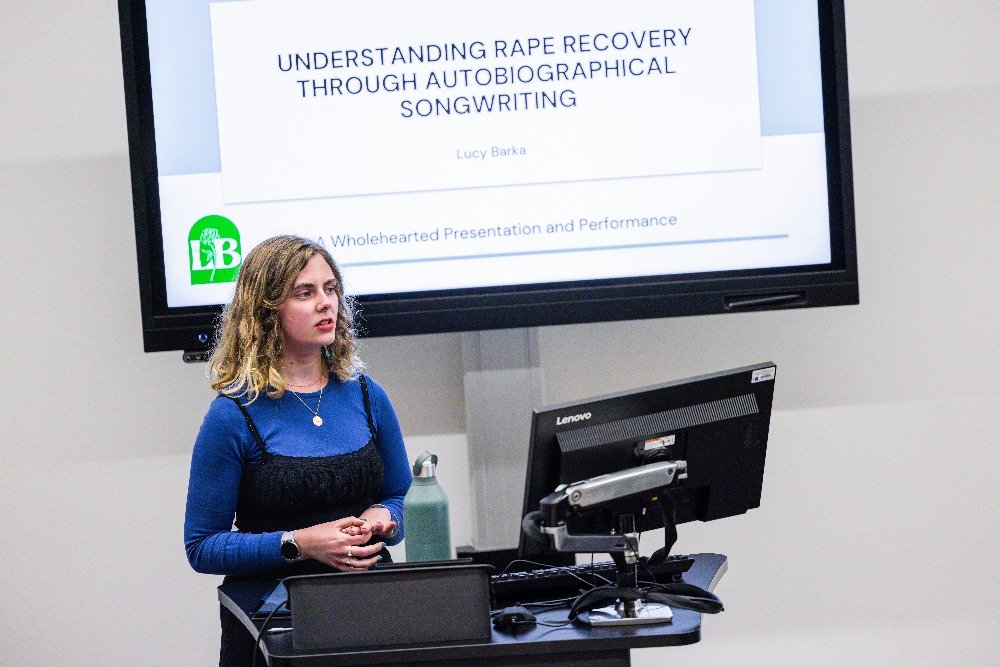
His wisdom and love was a guiding light of possibility and with his support, I began researching Understanding Rape Recovery Through Autobiographical Song Writing.
When I write, I become the compassionate observer.
I’m not in the experience, I’m looking at it from a step away, with self-forgiveness, with awareness of context, and with love.
Through my writing practices, I have come to love and accept myself, and that means in all forms and in all situations.
I have had to radically accept decisions and behaviours I made that I might choose differently now.
For example, I set out to write a song-letter to my seventeen-year-old self. It started off as advice: information so she could make “better decisions” on how to deal with what happened. I realised, only in writing the song, that wasn’t love. If I didn’t go through what I went through, exactly as I went through it, I wouldn’t be who I am today.
The lyric, arriving in verse 3:
I wish I could change the past
but I am where I am because of you.
So keep leaning on Ben cos he loves you and he’ll always be there.
And listen when he says you need to tell Mum and to not be scared.
‘Cos this won’t go away.
I see you.
Come back to your body.
I hear you.
Come back to your body.
If I am the compassionate observer for myself, I can consider what’s important to me and how I want to show up for myself, now, in the past, and in the future.
Using song to process the past
I find little pockets of agency in song.
Have you seen the film Sliding Doors, where the sliding doors of a train carriage split a woman’s reality into two parallel lives? I used that as an idea to help me process the victim blaming narrative of “I should have used violence to stop him”.
I wrote a song set in a parallel reality (like my own sliding doors moment) where I did use violence to stop the rape. The song was a safe space for me to explore and actually follow through on the answer to “what if”.
What if I used my force
To send him crashing
Into his bedside table
I’d be standing over
Shouting, “what the f**k are you doing?!”
Again, I realised I wouldn’t be where I am today, which is ~wonderful me~, and the narrative no longer had this pull to it, this gravity, because I was no longer scared of where the “what if” would lead me.
I got rid of shame - fear of being too much or not enough.
In Michaela Coel’s semi-autobiographical, and astounding, I May Destroy You, the protagonist, Bella (an author), writes alternative endings to her own rape recovery. Unable to find the perpetrator, she showed how, through your imagination, you can resolve the thing with this grip on you, taking out the gravity that pulls you down and stops you from being free.
These creative practices are so vital for recovery because they help you to witness, process, accept, connect, and find your agency and freedom. It was also in watching this series that I decided to progress the police investigation: I wanted him to feel it - to viscerally grasp an ounce of the suffering he had caused me.
All these feelings of revenge and anger is in the album too, of course.
Unlocking the box of shame through song
Songwriting has helped me in so many ways. I create new connections by sharing vulnerably, and new stories about who I'm becoming. The biggest way is taking away the weight of these narratives. I call it “semantic recovery” (semantic being the meaning of things, rather than ‘somatic recovery’ concerning the body). But all of this is a practice. It's a constant process of transformation, I guess.
Somatic healing is also vital. I avoided exercise for a long time because I was scared of my body, in a way, it felt unfamiliar. Panic attacks in the gym, ending sessions early, crying in pilates class. Your relationship with your body is so different, let alone when sharing it with others, and that's another place I felt I didn’t have agency anymore.
I've tried so hard not to think of recovery as getting back to what you were before, because you can't. You have to accept that you are fundamentally changed. From that truth, you can work upwards. And I slowly found my way, to my body, to my truth, to myself.
I honestly wouldn't change anything I’ve been through because I love where I am today.
Nearly two years ago now, I started dancing again. I’m still learning to protect myself from uncomfortable dances with entitled men but now I’m leading (it’s partner dancing), I mostly dance with people I trust and it’s a total joy.
It even came up in my song writing: I imagined dancing with myself as a child, where she invites me to dance, ‘and smiles with reckless abandon’... ‘I don’t know where I lost her, but now that I’ve found her, I won’t let her go’.
I also realised I was scared to say the word: rape.
The word itself had this heaviness. For years, I’d kept it quiet, boxed up, not wanting to make people feel uncomfortable by talking about it. But then I think to myself, why suffer on my own?
I don't have to apologise for someone else raping me. I don't want to feel the weight of that. It shouldn’t be me who’s wearing shame and bearing the burden of silence. It's not my responsibility.
In putting all the anger, shame, rage and revenge into song, it has changed my life. It gives me tools where I can reflect, take a step back, and say to myself, “wow, aren't I strong? Aren’t I resilient?” And it helps me to connect with the people around me in such a deep and authentic way. I never feel alone anymore.
The power of sharing survivor stories
Around the time I was writing the album, someone close to me shared about an experience of domestic violence and it opened up a conversation. Because she was so open, I shared with her that I was raped.
We spoke about violence and the shame we felt and there was this new understanding between us that has never gone away, an acknowledged, shared resilience.
I think most women (and my non-binary AFAB friends) have this shared resilience, even if we keep it private.
Whenever we say #MeToo, we’re also saying: I see you and the struggles you go through, I'm in the same fight with you.
There’s a strength there that we can recognise in each other:
I want you
to see the strength in me,
the same strength that I see in you.
The song I wrote, ‘Roses’, is about finding the beauty in and celebrating our shared resilience.
Looking ahead at a bright future
I have a lot to look forward to right now.
I’m now a fierce feminist, only part of that is being a survivor. Being a feminist for me is about taking up space authentically and courageously, helping other people do the same, and tackling the barriers to that.
I’m the best of who I’ve always been: bright and vibrant, a singer and a dancer.
I want to keep stepping up for myself and my personal growth. I have people around me that love and support me, and I love and support them, too.
I'm also excited to share this album and inspire the unboxing of other people’s shame. I'm really excited to see what comes out of that: the connections, the opportunities, and all the little transformations.
You can now listen to the first single of my album, Haunted, which came out Friday 30th October.
And I’ll be releasing at least 3 more singles in early 2027 before a big fat PARTY to launch the album.
I hope this music can soundtrack your own recovery journey - and be part of real social change to remove shame for survivors and prevent sexual violence.
Join me in this journey as I unite us in empathy, shared resilience, and a love of good music.
02 November 2026